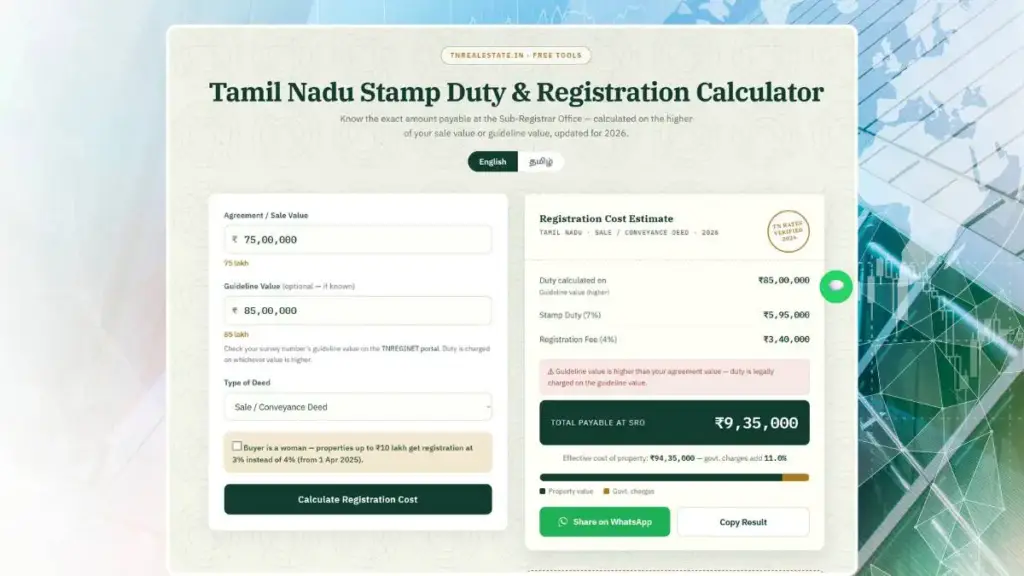
You have saved for years, negotiated the price, and finalised your dream property at ₹50 lakh. Then someone mentions “registration charges” — and you discover you need ₹5.5 lakh more in hand on registration day. If that number surprised you, you are not alone. This guide explains exactly how stamp duty and registration fees work in Tamil Nadu, the guideline value rule that catches most buyers off guard, and how to calculate your exact amount in 30 seconds.
The rates: what you pay in Tamil Nadu
For a standard sale deed in Tamil Nadu, you pay two charges at the Sub-Registrar Office (SRO):
| Charge | Rate | On a ₹50 lakh property |
|---|---|---|
| Stamp Duty | 7{23cefbf4ecd3fe9d43fe71273124b1d66835af779dee33298af8782c16b501b9} | ₹3,50,000 |
| Registration Fee | 4{23cefbf4ecd3fe9d43fe71273124b1d66835af779dee33298af8782c16b501b9} | ₹2,00,000 |
| Total | 11{23cefbf4ecd3fe9d43fe71273124b1d66835af779dee33298af8782c16b501b9} | ₹5,50,000 |
These rates are uniform across all 38 districts — a flat in Chennai, a plot in Coimbatore, and farmland near Madurai all attract the same percentages. Only the property values differ.
Concession for women buyers: From 1 April 2025, women registering property valued up to ₹10 lakh pay a reduced registration fee of 3{23cefbf4ecd3fe9d43fe71273124b1d66835af779dee33298af8782c16b501b9} instead of 4{23cefbf4ecd3fe9d43fe71273124b1d66835af779dee33298af8782c16b501b9}. On a ₹10 lakh property, that saves ₹10,000 — and it is one more reason families increasingly register smaller properties in the wife’s name.
👉 Skip the manual math: use our free Tamil Nadu Stamp Duty Calculator — it applies every rule below automatically, in English and Tamil.
The guideline value trap most buyers miss
Here is the rule that surprises even experienced buyers: stamp duty is not necessarily calculated on the price you paid. It is calculated on the higher of two values:
- Your sale/agreement value — the price you actually negotiated
- The guideline value — the government’s minimum value for that survey number
Suppose you negotiate a great deal at ₹48 lakh, but the guideline value of the plot works out to ₹55 lakh. The SRO will charge 11{23cefbf4ecd3fe9d43fe71273124b1d66835af779dee33298af8782c16b501b9} on ₹55 lakh (₹6,05,000), not on your ₹48 lakh (₹5,28,000). That is ₹77,000 more than you budgeted — discovered at the registration counter.
Before you fix your budget, check the guideline value of the exact survey number on the TNREGINET portal. It takes five minutes and can save you a nasty surprise.
What about other deed types?
Not every registration is a sale. Common family transactions get concessional rates:
- Gift deed to a family member: 1{23cefbf4ecd3fe9d43fe71273124b1d66835af779dee33298af8782c16b501b9} stamp duty (capped at ₹25,000) and 1{23cefbf4ecd3fe9d43fe71273124b1d66835af779dee33298af8782c16b501b9} registration fee (capped at ₹4,000)
- Settlement deed in favour of family: same concessional structure
- Exchange deed: 7{23cefbf4ecd3fe9d43fe71273124b1d66835af779dee33298af8782c16b501b9} + 4{23cefbf4ecd3fe9d43fe71273124b1d66835af779dee33298af8782c16b501b9} on the higher-valued property
So transferring a ₹60 lakh house to your son via settlement deed costs a maximum of about ₹29,000 — not ₹6.6 lakh. Families that don’t know this sometimes execute a full sale deed between relatives and pay lakhs unnecessarily. (Confirm current caps and eligible relations at your SRO before executing the deed.)
Can you claim tax benefit on stamp duty?
Yes. Stamp duty and registration charges paid on a residential property qualify for deduction under Section 80C — up to the overall ₹1.5 lakh limit, in the year of payment, under the old tax regime. For a couple buying jointly, both can claim their share proportionately. Keep the payment receipts; your CA will need them.
Registration day: what to carry
Beyond the money, keep these ready for the SRO appointment: the sale deed drafted on stamp paper, patta/chitta copies, encumbrance certificate, both parties’ Aadhaar and PAN, passport photos, and the payment challans. Stamp duty in TN is typically paid via e-stamping or challan before the appointment — the SRO does not accept the duty amount in cash across the counter.
Calculate your exact amount now
Every property is different — sale value, guideline value, deed type, and buyer category all change the final figure. Our free calculator handles all of it:
→ TN Stamp Duty & Registration Calculator — enter your values, get the exact SRO-day amount, and share the result on WhatsApp with your family or lawyer.
Also useful before you buy: our Tamil Land Unit Converter (cent, ground, kuzhi, ma, veli) and the UDS Calculator for flat buyers.
Disclaimer: Rates as published by the TN Registration Department as of 2026, subject to revision. Verify at TNREGINET or your Sub-Registrar Office before payment. This article is general information, not legal advice.